How to Sell on Amazon USA from Canada in 2027
Canadian businesses can sell products on Amazon.com using a supported Amazon seller account without generally needing US incorporation. They can choose FBA or merchant fulfilment, manage cross-border requirements and receive sales proceeds through an approved payout arrangement.
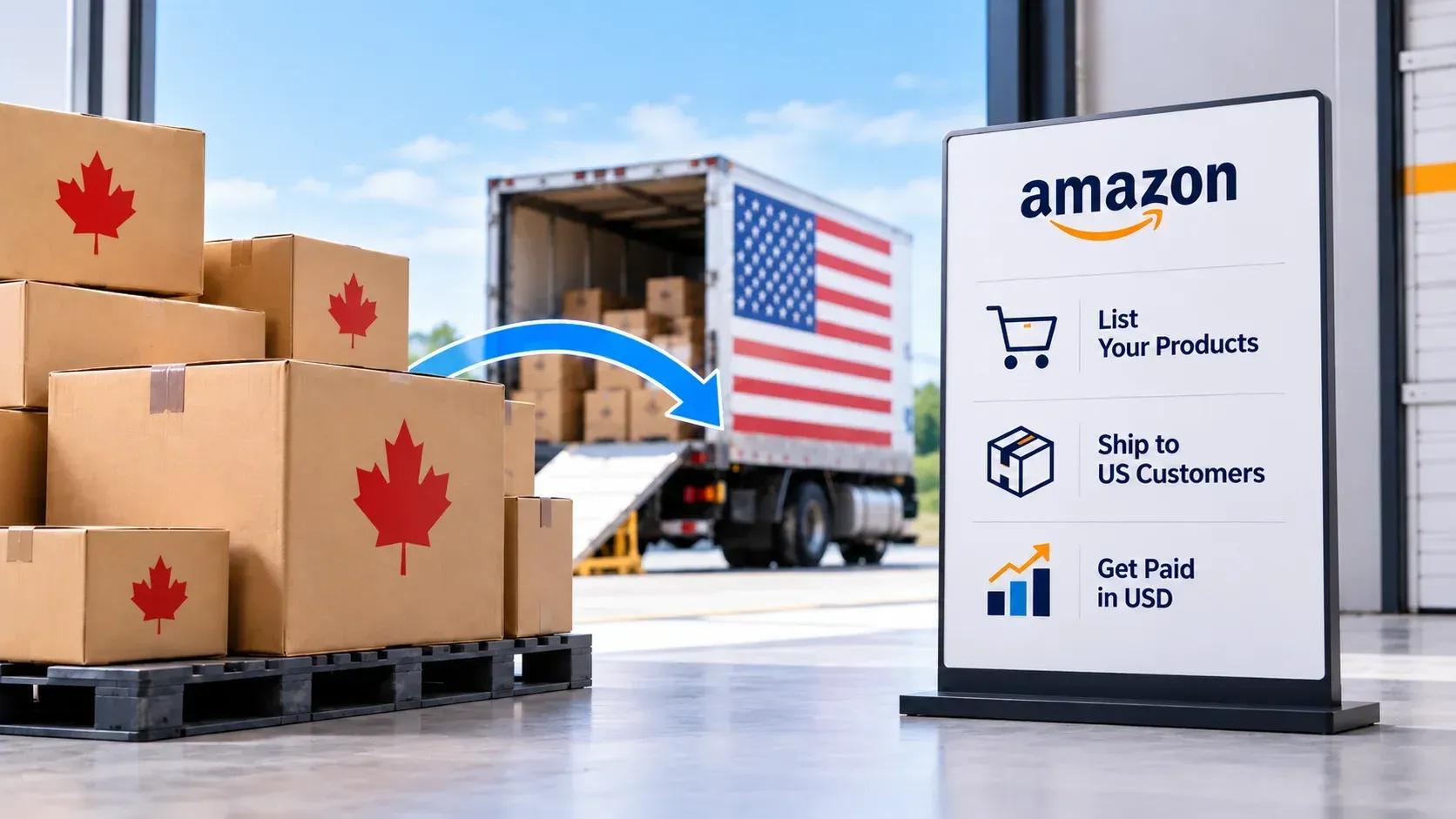
Canadian businesses can sell on Amazon USA without establishing a US company or opening a US bank account solely to register as a seller. Through Amazon's regional selling system, you can list products on Amazon.com, reach American customers and choose whether to handle shipping yourself or use Amazon's fulfilment network.
However, selling on Amazon USA from Canada involves more than setting up a seller account. You need to account for marketplace fees, shipping arrangements, US customs requirements and the way your USD sales proceeds will be received and converted.
For Canadian business owners and ecommerce teams, this guide explains how to sell on Amazon USA from Canada, compare fulfilment options, calculate selling costs and manage USD earnings.
Can Canadian businesses sell on Amazon USA?
Yes. Canadian businesses can sell products directly to American customers through Amazon.com using Amazon's Global Selling programme. You can operate from Canada, manage your listings through Seller Central and choose a fulfilment arrangement that suits your business.
Amazon's North America and Brazil unified account allows Canadian businesses to manage selling activities across supported Amazon marketplaces, including the US, Canada, Mexico and Brazil. Sellers can use Seller Central to manage marketplace access, product listings and account settings, subject to Amazon's registration and verification requirements.
You don't generally need a US LLC, physical office or US bank account simply to register. However, your business must still meet Amazon's requirements for identity verification, product compliance, fulfilment, taxation and receiving payments. Before expanding, consider three important questions:
- Can your products be sold in the US? Some categories require approval, and Canadian product certifications may not satisfy US requirements.
- Can you deliver orders profitably? With merchant fulfilment, you can ship orders directly from Canada to US customers, while Amazon FBA generally requires sending inventory into Amazon's fulfilment network. Each approach has different shipping, storage and fulfilment costs.
- How will you receive your earnings? Amazon.com sales are in USD, but your payout arrangement determines whether those proceeds remain in USD or are converted into CAD.
Addressing these questions early helps you assess the commercial opportunity before committing to inventory and marketplace expenses.
How do you start selling on Amazon USA from Canada?
There is no exact method to define how to sell on amazon USA from Canada. Primarily, you need to register or expand your seller account, prepare compliant product listings, select a fulfilment method and configure your payment details.
1. Register or expand your Amazon seller account
If your business already sells on Amazon.ca, check the Sell Globally dashboard in Seller Central. You may be able to expand into Amazon.com through your existing unified account.
New sellers can create a Professional North America and Brazil unified selling account using Amazon's registration process. Amazon may request the following information:
- Your legal business name, address and registration details.
- Government-issued identification for the relevant representative.
- A valid email address and telephone number.
- An internationally chargeable credit card.
- Bank account information for disbursements.
- Tax details and supporting verification documents.
The precise requirements depend on your business structure and circumstances. Use the correct legal information for your Canadian corporation, partnership or sole proprietorship.
Amazon also requires sellers to complete a tax interview. This helps the platform determine the appropriate tax documentation, but it does not replace an assessment of your business's actual US tax obligations.
2. Choose products that meet US marketplace requirements
Products already sold on Amazon.ca cannot automatically be assumed to meet every Amazon.com requirement. Before launching, check US restrictions, safety standards, labelling rules and any category-specific approvals. Certain products may also require documentation from a manufacturer or proof that your business is authorized to sell the brand.
For example, a Canadian company selling electrical accessories may need to demonstrate compliance with US safety requirements, even when the same products are approved for the Canadian market.
Amazon's Global Selling resources explain marketplace-specific compliance requirements and tools for assessing product opportunities.
3. Create product listings for American customers
Once your products are approved, prepare your Amazon.com listings with accurate descriptions, images, specifications and pricing in USD.
If Amazon already has a catalogue page for a product you sell, you may be able to match your offer to that listing. Otherwise, you'll need to create a new product detail page using the required identifiers and information. Pay particular attention to:
- Product descriptions, measurements and packaging information.
- US-specific safety and labelling requirements.
- Competitive pricing after marketplace and delivery costs.
- Available inventory and realistic delivery expectations.
Businesses expanding from Amazon.ca can also investigate Amazon's listing tools to reduce repetitive work across marketplaces.
4. Configure fulfilment and payment arrangements
Before accepting orders, decide where your inventory will be stored and how products will reach customers. Using Amazon FBA from Canada involves arranging inventory delivery to Amazon’s US fulfilment network, while merchant fulfilment allows you to manage shipping through your own warehouse or logistics partners.
At the same time, configure your Amazon deposit method and check the payout currency. A business expecting to retain USD should understand its receiving options before allowing Amazon to convert proceeds into CAD. Compare exchange rates before making international business payments.
| Field | Value |
|---|---|
Amount Payable (CAD) 85,000 | |
Bank Exchange Rate 0.7166 / 1.3954 | |
Total cost 60,912.82USD |
| Field | Value |
|---|---|
Amount Payable (CAD) 85,000 | |
MTFX Exchange Rate 0.7043 / 1.4198 | |
Total cost 59,867.75USD |
You Save
USD 1,045.07
with MTFX
25 November 2026
We use mid-market rates. This is for informational purposes only. Log in to view send rates.
Should Canadian sellers use Amazon FBA or FBM?
Canadian sellers can fulfil US orders through Fulfilment by Amazon (FBA) or Fulfilled by Merchant (FBM). The choice depends on your inventory strategy, delivery requirements and total operating costs.
How does Amazon FBA USA from Canada work?
With FBA, you arrange for inventory to reach Amazon's US fulfilment network. Amazon then handles storage, picking, packing, shipping and much of the fulfilment-related customer service and returns process. This can be useful for businesses selling regularly to American customers because individual orders no longer need to be dispatched from Canada.
However, using Amazon FBA from Canada means budgeting for inbound freight, import duties, fulfilment charges and storage fees. Consider a Canadian kitchenware company planning to sell several hundred units per month in the US. Shipping inventory in larger quantities to US fulfilment centres may be operationally easier than sending every customer order separately across the border.
Whether it costs less depends on the products, their dimensions, sales volume and the applicable Amazon fees.
Amazon FBA vs FBM: Which is suitable for your business?
Before accepting US orders, set up returns that meet Amazon’s international-return requirements. Depending on the circumstances, you may need a US return address, prepaid international return labels or refunds without a return. Process refunds within Amazon’s required timelines and budget for shipping goods back to Canada, applicable customs or brokerage charges, and losses on damaged or unsellable stock.
How much does it cost to sell on Amazon USA in 2026–2027?
Selling costs depend on the products you offer, the Amazon plan you use and how customer orders are fulfilled. Your budget should include selling-plan charges, referral fees, fulfilment and shipping costs, customs expenses, returns, advertising and any applicable currency conversion costs.
The total cost of Amazon FBA USA from Canada includes inbound freight, applicable duties, fulfilment charges, storage and other inventory-related fees.
Amazon US seller fees: Selling plans and referral charges
Amazon US seller fees include selling-plan charges and referral fees, with additional costs depending on the fulfilment services and other programmes you use. The published US selling-plan charges are shown below.
In addition to the selling plan, Amazon charges referral fees. These vary by product category and are generally based on a percentage of the item's total sale price, subject to applicable category rules and minimum fees.
Amazon FBA fulfilment and storage costs
Businesses using FBA must also budget for storing and fulfilling their products. Amazon's fulfilment fees depend on factors such as product size, shipping weight and price. Storage charges and other inventory-related fees can apply separately.
Two published fee developments are particularly relevant to sellers operating during late 2026 and early 2027:
- Fuel and logistics surcharge: From April 17, 2026, Amazon introduced a 3.5% surcharge on applicable FBA fulfilment fees in the US and Canada. This is calculated against the relevant fulfilment fee, not the item's selling price.
- Holiday peak fulfilment fees: Applicable peak fees run from October 15, 2026, through January 14, 2027. The fuel and logistics surcharge also applies to the relevant peak fulfilment fees.
The exact amount depends on the applicable rate card and product characteristics. Review the current US FBA fulfilment fee schedule in Seller Central when pricing products for 2027.
Example: How much can a Canadian seller earn from a US$50 sale?
Suppose a Canadian homeware business sells a product for US$50 on Amazon.com. Its estimated costs might look like this:
These amounts are illustrative rather than actual Amazon charges. Other costs, including returns, taxes, overhead and currency conversion, have not been included. The example shows why US sales revenue should not be confused with business profit.
A Canadian seller may generate healthy Amazon sales but retain a much smaller margin once fulfilment, logistics and foreign-exchange expenses are included.
What additional expenses should Canadian sellers budget for?
Beyond Amazon's selling fees, Canadian businesses need to prepare for the expenses involved in launching, importing inventory and maintaining US marketplace operations.
Some costs occur before your first sale, while others increase as order volumes grow. Separating these expenses makes it easier to determine how much working capital your business needs before entering the US market.
- Initial inventory: Purchasing or manufacturing enough products to support your planned US launch.
- Product testing and compliance: Obtaining applicable certifications, safety testing and documentation required for the US market.
- Product listings: Preparing photography, descriptions, product identifiers and other listing materials.
- Packaging and labelling: Adapting products to US marketplace requirements, including any Amazon FBA preparation rules.
- Inbound freight: Transporting goods from Canada or another sourcing country to a US warehouse or fulfilment centre.
- Customs and brokerage: Paying applicable duties, clearance charges and other import-related expenses.
Businesses already selling the same products in Canada may have some of these resources available. However, expanding into the US can still require additional investment in compliance, shipping and inventory preparation.
Ongoing expenses after launching on Amazon.com
Once sales begin, recurring operating costs become just as important as the initial investment.
These expenses vary by product category, inventory location, supplier arrangements, fulfilment method and the services your business uses. Not every cost applies to every seller.
Example: Planning the expenses for your first US inventory shipment
Consider a Canadian ecommerce business preparing its first shipment of products to a US fulfilment centre. Its initial spending plan might look like this:
This is an illustrative budget rather than an estimate of what a typical Amazon seller will pay. Actual costs depend on the products, import classification, shipping method and business requirements.
What customs and tax rules apply when selling on Amazon USA?
Canadian businesses selling to US customers must consider the customs and tax rules of both countries. Requirements vary based on the goods, fulfilment arrangement and business activities.
Who handles customs when inventory enters the United States?
When you import products into the US, someone must take responsibility for customs documentation, applicable import duties and clearance requirements. For FBA inventory shipments, Amazon does not act as the importer of record. The seller or an appointed party must arrange that responsibility and ensure the goods can legally enter the country.
Canadian sellers should no longer assume that goods valued at US$800 or less automatically qualify for duty-free entry. Applicable duties, taxes and exceptions depend on current US rules and the particular goods. Before shipping inventory, review US Customs and Border Protection guidance and confirm the requirements for your products.
Do Canadian Amazon sellers need to collect US sales tax?
Amazon generally collects and remits applicable sales taxes in US jurisdictions where marketplace facilitator laws require it. However, this does not mean every Canadian seller is exempt from registration, income-tax reporting or other obligations.
The location of your inventory, your business activities and the type of products sold can affect your responsibilities. US income-tax filing requirements must also be considered separately from sales-tax collection.
For Canadian corporations with relevant US business activities, the IRS guidance on foreign-corporation filing obligations provides a useful starting point.
What Canadian tax obligations remain?
Canadian businesses must continue maintaining appropriate accounting and tax records for their cross-border operations. Keep records of Amazon sales, marketplace deductions, refunds, import charges, foreign-currency transactions and settlement amounts.
Some exports may qualify for zero-rated GST/HST treatment when the relevant conditions are met. The Canada Revenue Agency's guidance on imports and exports explains the circumstances in which this can apply.
Because US and Canadian obligations can overlap, obtain professional tax advice based on your business structure, inventory locations and transactions.
How do Canadian Amazon sellers receive their USD earnings?
Canadian businesses selling on Amazon.com can receive their earnings through supported payout arrangements. Depending on their account setup, sellers may use Amazon Currency Converter for Sellers, Amazon Seller Wallet where available, or an accepted US bank account or participating payment service provider.
Before choosing an option, compare the payout currency, conversion fees, settlement times and receiving-account requirements. Businesses regularly paying US suppliers may also benefit from retaining USD when their payout arrangement supports it.
Receive CAD through Amazon Currency Converter for Sellers
Amazon Currency Converter for Sellers (ACCS) allows sellers to receive supported foreign marketplace proceeds in their local currency.
For a Canadian seller with a compatible Canadian bank account, this usually means Amazon converts USD proceeds into CAD as part of the disbursement process.
The service can be convenient, but currency conversion affects the final amount received. Amazon publishes a volume-based fee schedule for ACCS:
These are the standard published tiers for applicable conversions. Fees and availability differ for certain currencies and marketplaces.
The conversion rate is determined when Amazon initiates the transfer, and the service fee is reflected in the conversion arrangement. You can review the terms through Amazon Currency Converter for Sellers.
Hold USD through Amazon Seller Wallet
Amazon Seller Wallet provides another way for supported Amazon.com sellers to manage USD proceeds. Instead of immediately converting available funds, a business with access to Seller Wallet can hold USD, choose when to transfer certain amounts and make supported payments.
For Canadian businesses with ongoing US expenses, the ability to manage USD separately may be useful. However, Seller Wallet has its own account requirements, supported destinations and transfer fees. Transfers to Canadian bank accounts are generally made in CAD, even when the receiving bank offers a foreign-currency account.
Sellers should check the actual transfer currency and charges before moving funds out of their wallet.
Receive USD through a supported US bank or payment account
Some Canadian businesses use an acceptable US-based bank account to receive USD proceeds without converting them immediately. This may suit companies paying American suppliers, purchasing US inventory or maintaining recurring USD expenses.
Amazon also permits certain accounts issued by participating payment service providers, but it restricts the types of accounts that can receive marketplace disbursements.
If you plan to use a third-party receiving account, verify that the account meets Amazon's Payment Service Provider Program requirements. A receiving account offering US bank details is not automatically accepted for Amazon seller payouts.
Which Amazon payout arrangement should you choose?
For businesses selling through multiple channels, establishing a consistent international collections workflow can also make it easier to reconcile foreign-currency receipts with individual marketplace settlement statements.
How do exchange rates affect profits from Amazon US sales?
Exchange rates influence the Canadian-dollar value of USD sales proceeds and can also affect the cost of paying suppliers overseas. For Canadian businesses with narrow product margins, even a small difference in the effective conversion rate may be worth reviewing.
Compare the amount received after conversion
Consider a Canadian ecommerce business with US$25,000 available for conversion into CAD. Two illustrative effective exchange rates produce different results:
The difference is CAD$250 on the same USD amount. These rates are hypothetical and are assumed to include all conversion charges. They are not current quotes from Amazon, a bank or MTFX.
The example illustrates why businesses should compare the net CAD amount received, including the exchange rate and applicable fees, instead of relying only on advertised rates.
Its always best to monitor currency movements before reviewing an actual business conversion quote.
Receive US dollars and hold or convert at your convenience.
What is the best way to convert USD and pay international suppliers?
The most suitable arrangement depends on where your USD funds are held, which currencies your suppliers accept and when payments are due.
Canadian sellers should compare traditional bank services with specialist online foreign-exchange and business-payment providers rather than assuming that one method is always less expensive.
Compare banks and specialist FX providers
The lowest advertised fee does not necessarily produce the lowest overall cost. A provider may charge less upfront but offer a less favourable exchange rate, or vice versa.
For a reliable comparison, use the same transfer amount, currency pair, recipient details and payment deadline. Then compare the final amount received after all charges.
Match supplier payments to your USD revenue
Canadian Amazon businesses often make recurring payments for inventory, packaging, freight, advertising and other operating needs. If your business regularly pays US suppliers in USD, using available USD balances may reduce the need to convert funds repeatedly.
For suppliers in other countries, the invoice currency becomes particularly important. A manufacturer may quote in USD even when operating outside the United States, while another may request its local currency.
Using an appropriate international supplier payment solution can help businesses manage supported foreign-currency transfers and monitor related payment costs.
Manage cash flow as sales volumes increase
As order volumes grow, the timing of marketplace settlements and supplier payments becomes increasingly important.
Inventory may need to be paid for before the related products generate revenue. Amazon can also withhold portions of a seller's balance under applicable reserve and settlement policies. A payment calendar can bring these obligations together by recording:
- Expected Amazon settlements and payout currencies.
- Inventory deposits and supplier payment deadlines.
- Shipping, duty and fulfilment charges.
- Required CAD conversions for Canadian expenses.
- Available foreign-currency balances and expected shortfalls.
This allows finance teams to distinguish money earned from money currently available to spend.
For businesses with significant recurring currency exposure, treasury management solutions may also help coordinate payments, liquidity and foreign-exchange risk.
What should Canadian businesses check before launching on Amazon USA?
Before opening your US marketplace listings, confirm that the commercial and payment arrangements are ready.
- Review your account requirements. Make sure your Canadian business information, verification documents and tax details are complete.
- Confirm product compliance. Check applicable US product standards, marketplace restrictions and import requirements.
- Choose your fulfilment method. Compare Amazon FBA and merchant fulfilment based on inventory volumes, shipping costs and delivery performance.
- Calculate your complete selling costs. Include referral fees, storage, fulfilment, shipping, duties, returns and advertising.
- Verify your receiving account. Check whether Amazon supports your bank or payment service provider and confirm the payout currency.
- Plan your foreign-currency needs. Separate USD amounts required for supplier payments from funds that must be converted into CAD.
- Monitor profitability after launch. Reconcile marketplace settlements with fees, operating expenses and actual currency conversion results.
These checks give your business a clearer view of the real cost of selling in the United States and help reduce avoidable payment and fulfilment problems.
Build US sales around the revenue you actually keep
Selling on Amazon USA from Canada can help your business reach a larger customer base, but expanding successfully requires more than competitive products and attractive listing prices. Marketplace fees, customs duties, fulfilment arrangements and currency conversion all influence how much of your US revenue contributes to business profitability.
With a clear understanding of Amazon's selling requirements and a reliable process for managing international payments, your business can approach US expansion with greater financial visibility and better control over its operating costs.
Open a business account to review supported currency conversion, collection and supplier-payment options for your ecommerce business.
FAQs
1. Can Canadians sell on Amazon USA without a US company?
Yes. Canadian businesses can generally sell on Amazon.com without registering a US company solely to open a seller account. However, legal, tax and operational circumstances may make a US entity useful or create additional obligations.
2. Do Canadian sellers need a US bank account for Amazon.com?
No. Canadian sellers can receive supported Amazon.com payouts into compatible Canadian bank accounts through Amazon Currency Converter for Sellers. A US account may be useful when your business wants to retain USD.
3. How much does selling on Amazon USA from Canada cost?
Amazon's published US Individual plan costs US$0.99 per item sold, while the Professional plan costs US$39.99 per month. Beyond these Amazon US seller fees, budget for fulfilment, inventory storage, customs, shipping, returns, advertising and currency conversion.
4. Can Canadian sellers ship Amazon.com orders directly from Canada?
Yes. Sellers using Fulfilled by Merchant can arrange shipments from Canada to American customers, provided they meet Amazon's delivery, customer service and other applicable requirements.
5. Can Canadian businesses use Amazon FBA USA from Canada?
Yes. Canadian businesses can use Amazon FBA from Canada to serve US customers by sending inventory to the appropriate US fulfilment network and meeting Amazon’s preparation, customs and import requirements.
6. Does Amazon automatically convert USD sales proceeds into CAD?
Amazon converts supported proceeds into CAD when sellers use ACCS with an appropriate Canadian receiving account. Other supported arrangements, including Seller Wallet and acceptable US bank accounts, provide different currency-management options.
7. What fees does Amazon Currency Converter for Sellers charge?
For applicable conversions, Amazon publishes volume-based fees ranging from 1.5% to 0.75%, depending on trailing 12-month cross-currency net proceeds. Sellers should check the fee and conversion details for their account and payout currency.
8. Can Canadian Amazon sellers keep their sales earnings in USD?
Yes, through supported arrangements that allow USD balances or disbursements. Available options may include Amazon Seller Wallet and acceptable US-based bank accounts. Access and transfer restrictions depend on the arrangement.
9. Do Canadian businesses have to pay US taxes when selling on Amazon.com?
US tax responsibilities depend on the business structure, activities and applicable tax rules. Amazon may collect marketplace sales taxes, but Canadian sellers can still have other US or Canadian tax obligations.
10. What is the best way for Canadian sellers to receive Amazon USA payments?
The most suitable method depends on whether the business needs CAD immediately, wants to retain USD or has recurring international expenses. Compare supported payout methods, conversion charges, settlement times and receiving-account requirements before deciding.
Disclaimer: This article provides general information based on publicly available requirements and policies reviewed in October 2026. Amazon fees, account requirements, fulfilment policies, customs regulations and payment arrangements may change during 2027. Tax and legal obligations depend on individual business circumstances. Confirm the applicable rules and consult qualified professionals before making business decisions.